<?xml version="1.0" encoding="utf-8"?><feed xmlns="http://www.w3.org/2005/Atom" ><generator uri="https://jekyllrb.com/" version="3.10.0">Jekyll</generator><link href="https://gildersleve.uk/feed.xml" rel="self" type="application/atom+xml" /><link href="https://gildersleve.uk/" rel="alternate" type="text/html" /><updated>2026-01-15T10:47:07+00:00</updated><id>https://gildersleve.uk/feed.xml</id><title type="html">Dr Patrick Gildersleve</title><subtitle>Dr Patrick Gildersleve&apos;s academic website, featuring a bio, research and teaching info, and personal blog.</subtitle><author><name>{&quot;name&quot;=&gt;nil, &quot;avatar&quot;=&gt;&quot;/assets/images/bio.jpg&quot;, &quot;bio&quot;=&gt;&quot; &quot;, &quot;location&quot;=&gt;nil, &quot;email&quot;=&gt;nil, &quot;links&quot;=&gt;[{&quot;label&quot;=&gt;&quot;p.gildersleve@exeter.ac.uk&quot;, &quot;icon&quot;=&gt;&quot;fas fa-fw fa-envelope&quot;, &quot;url&quot;=&gt;&quot;mailto:p.gildersleve@exeter.ac.uk&quot;}, {&quot;label&quot;=&gt;&quot;Google Scholar&quot;, &quot;url&quot;=&gt;&quot;https://scholar.google.co.uk/citations?user=3CTTLDgAAAAJ&quot;, &quot;icon&quot;=&gt;&quot;fas fa-fw fa-graduation-cap&quot;}, {&quot;label&quot;=&gt;&quot;@gildersleve.uk&quot;, &quot;icon&quot;=&gt;&quot;fab fa-fw fa-bluesky&quot;, &quot;url&quot;=&gt;&quot;https://bsky.app/profile/gildersleve.uk&quot;}, {&quot;label&quot;=&gt;&quot;@pgildersleve&quot;, &quot;icon&quot;=&gt;&quot;fab fa-fw fa-x-twitter&quot;, &quot;url&quot;=&gt;&quot;https://x.com/pgildersleve&quot;}, {&quot;label&quot;=&gt;&quot;gildersleve@mastodon.social&quot;, &quot;icon&quot;=&gt;&quot;fab fa-fw fa-mastodon&quot;, &quot;url&quot;=&gt;&quot;https://mastodon.social/@gildersleve&quot;}, {&quot;label&quot;=&gt;&quot;@pgilders&quot;, &quot;icon&quot;=&gt;&quot;fab fa-fw fa-github&quot;, &quot;url&quot;=&gt;&quot;https://github.com/pgilders&quot;}, {&quot;label&quot;=&gt;&quot;LinkedIn&quot;, &quot;url&quot;=&gt;&quot;https://www.linkedin.com/in/gildersleve/&quot;, &quot;icon&quot;=&gt;&quot;fab fa-fw fa-linkedin&quot;}]}</name></author><entry><title type="html">Grokipedia falls flat, but AI is already rewriting Wikipedia’s future</title><link href="https://gildersleve.uk/Grokipedia-falls-flat,-but-AI-is-already-rewriting-Wikipedia-s-future/" rel="alternate" type="text/html" title="Grokipedia falls flat, but AI is already rewriting Wikipedia’s future" /><published>2025-11-17T09:00:00+00:00</published><updated>2025-11-17T09:00:00+00:00</updated><id>https://gildersleve.uk/Grokipedia-falls-flat,-but-AI-is-already-rewriting-Wikipedia%E2%80%99s-future</id><content type="html" xml:base="https://gildersleve.uk/Grokipedia-falls-flat,-but-AI-is-already-rewriting-Wikipedia-s-future/"><![CDATA[<p><em>Originally published on the <a href="https://blogs.lse.ac.uk/impactofsocialsciences/2025/11/17/grokipedia-falls-flat-but-ai-is-already-rewriting-wikipedias-future/">LSE Impact Blog</a></em></p>

<p>Elon Musk’s xAI recently launched Grokipedia – an AI-powered digital encyclopaedia designed to take on Wikipedia. The platform apparently uses the Grok chatbot to generate and fact-check articles at scale, promising a “massive improvement” over the encyclopaedia anyone can edit.</p>

<p>How, really though, has Grokipedia attempted to enhance the digital encyclopaedia experience? Mostly by <a href="https://www.politifact.com/article/2025/nov/12/Grokipedia-Wikipedia-AI-citations/">copying Wikipedia’s content</a>, repackaging carefully cultivated bias as <a href="https://www.wired.com/story/elon-musk-launches-grokipedia-wikipedia-competitor/">“neutrality”</a>, adding a <a href="https://meduza.io/en/feature/2025/10/30/grokipedia-vs-ruwiki">sprinkle of disinformation</a>, and removing many of the features that made Wikipedia such a successful successor to traditional encyclopaedias in the first place.</p>

<h1 id="new-knowledge-production-models">New knowledge production models</h1>

<p>Grokipedia is not the first challenger to Wikipedia. Estranged co-founder Larry Sanger’s Citizendium, Microsoft’s Encarta, Google’s Knol, the blockchain powered Everipedia, or spinoffs such as Conservapedia, Russia’s Ruwiki, China’s Baidu Baike have all attempted to offer alternatives, with different models for editorial control and varying degrees of (usually limited or localised) success.</p>

<p>Wikipedia’s own model, radically open and volunteer-governed, was a shock to traditional encyclopaedia production in the early 2000s. Whilst not without its own issues of <a href="https://blogs.lse.ac.uk/impactofsocialsciences/2021/11/18/seeing-the-world-like-wikipedia-what-you-should-know-about-how-the-worlds-largest-encyclopedia-works/">systemic biases, uneven global representation, contested histories</a>, it has grown into a remarkably reliable piece of knowledge infrastructure, when regarded with a healthy critical eye. New AI-driven models pose a different kind of challenge. Wikipedia is a flagship of the open Web, the hyperlink paradigm making referencing sources the default mode of knowledge production and information search.</p>

<p>The advent of LLMs marks a shift towards personalised summaries divorced or obfuscated from their provenance. Increasing centralisation of tech power places the architecture of information access further within a narrow set of corporate actors, with little transparency or accountability. This is a <a href="https://www.techpolicy.press/with-grokipedia-topdown-control-of-knowledge-is-new-again/">top-down assertion of epistemic authority</a> being awarded to the highest bidder; usually Musk himself, or those who <a href="https://blogs.lse.ac.uk/impactofsocialsciences/2023/04/14/social-media-has-changed-will-academics-catch-up/">subscribe to his ideals</a> (very directly £8 per month for a blue check on X), whom Grokipedia prioritises as a source.</p>

<p>Wikipedia editors themselves remain <a href="https://en.wikipedia.org/wiki/Wikipedia:WikiProject_AI_Cleanup">broadly resistant to generative AI in the editing process</a>, having previously embraced <a href="https://stuartgeiger.com/bots-cyborgs-halfaker.pdf">carefully controlled editing by simple bots</a>, with the <a href="https://wikimediafoundation.org/news/2025/04/30/our-new-ai-strategy-puts-wikipedias-humans-first/">Wikimedia Foundation also remaining cautious</a>. Where general Web users have adopted LLMs for many tasks, Wikipedia editors deeply involved in the direct labour and governance of knowledge production on the Internet see LLMs as both philosophically and practically antithetical to their craft. Some users have and will continue to edit Wikipedia with generative AI tools, both in good and bad faith, but Grokipedia represents an outsourcing of knowledge work to the AI model itself (with the rather huge caveat that much of Grokipedia’s content is simply <a href="https://www.arxiv.org/pdf/2510.26899">lifted directly from Wikipedia</a>, with the underlying Grok LLM <a href="https://aclanthology.org/2024.wikinlp-1.14/">likely also being trained on Wikipedia</a> and other open resources).</p>

<h1 id="the-grokipedia-experience">The Grokipedia experience</h1>

<p>It is rather striking how bare-bones the Grokipedia site is. A simple search bar takes the user to an article of choice (885K compared to English Wikipedia’s 7.1m), where they are met by a block of encyclopaedic text. One is able to highlight sections to “Ask Grok”, which takes the text, divorced from any other context or link to Grokipedia, into a session with the chatbot, or to “suggest an edit”, inviting the user to submit improvements. It is unclear, however, how this feature really works, with suggestions seemingly reviewed by the Grok chatbot and integrated or rejected according to criteria and processes kept opaque to users.</p>

<p>Contrast this with Wikipedia’s system. A simple site to be sure, fundamentally not that different from its 2001 origins, but one that offers users numerous ways to transparently and directly engage: full edit histories of every article, discussion pages where contributors debate content, clear rules on verifiability and neutrality, plus of course, the ability for anyone to edit directly.</p>

<h1 id="networked-authority-in-the-encyclopaedia-with-breaking-news">Networked authority in the encyclopaedia with breaking news</h1>

<p>One of Wikipedia’s many powers is its deep integration with the World Wide Web. Internal hyperlinks allow you to browse related articles and wander down rabbit-holes. References on Wikipedia link to external sites where possible. Beyond its immediate utility, this embrace of Web technologies is what led to it being ranked highly in the early days of Google results, and its subsequent continued success in it being heavily linked to from elsewhere today.</p>

<p>On these points, Grok does not feature internal hyperlinks to support browsing beyond the immediate article. It exclusively references web-based content, not offline resources such as physical books and historical texts. And, across many attempted searches (“Elon Musk”, “Tesla Grokipedia”, “BBC Grokipedia article”, …), its articles barely appear in the front page of rankings of the great gatekeeper, Google. One notable exception; searching for “Elon Musk Grokipedia page” does yield the desired article second in the rankings (below Musk’s Wikipedia page). Since a peak in Google queries on its launch, <a href="https://trends.google.com/trends/explore?date=2025-10-17%202025-11-17&amp;q=grokipedia,wikipedia&amp;hl=en-GB">direct search traffic to Grokipedia has dwindled</a>, to say nothing of the likely even smaller share of referrals directly to Grokipedia articles.</p>

<p>Unless a user deliberately navigates to grokipedia.com then searches for a specific article, they are unlikely to encounter its content. They are also unlikely to be sent there from elsewhere, even X or Grok itself. It does not have the credibility among general users, and competitor tech platforms have little incentive to boost a rival, when reliable Wikipedia exists or they have their own chatbots to lock users into. Grokipedia’s static, isolated articles also mean that even once on the platform, any form of curiosity or serendipitous discovery is unlikely.</p>

<p>At the time of writing, Grok articles display a badge marking “fact checked by Grok three weeks ago”, an eternity in the Internet age. One of Wikipedia’s key draws is that its volunteer editors <a href="https://wikipedia20.mitpress.mit.edu/pub/vcka4poc/release/5">keep it up to date with current events</a>. Since Grokipedia’s launch, Donald Trump’s Wikipedia article (only editable by the most experienced editors due to vandalism issues) has been <a href="https://en.wikipedia.org/w/index.php?title=Donald_Trump&amp;action=history">updated 185 times</a>. In the same period, just one change has been approved on his <a href="https://grokipedia.com/page/Trump">Grokipedia article</a>, with six further rejected or still under review. As such, Grokipedia is more of a stale automated remix of a living commons than a truly AI-enhanced upgrade (if such a thing could ever exist).</p>

<h1 id="what-really-is-grokipedia">What really is Grokipedia?</h1>

<p>Ultimately, Grokipedia as a product is a low-effort proof-of-concept, in its current form not a true challenger to Wikipedia. It offers none of the adaptable, conversational affordances that draw users to AI chatbots, to say nothing of its content errors, biases, and weak claims to authority. It also offers a frankly bad digital encyclopaedia experience – an out of date, barely functional piece of hypertext. Features may improve, presumably with deeper integration with Grok and X, but it is hard to see how anyone not deeply ingrained in Musk’s tech ecosystem will ever come to rely on or encounter it.</p>

<p>Grokipedia is, however, two things:</p>

<p>Firstly, it is a position piece – another part of Musk’s <a href="https://gildersleve.uk/Elon-Musk-is-right-about-Wikipedia/">continued</a> <a href="https://www.snopes.com/fact-check/elon-musk-stop-donating-wikipedia/">attacks</a> <a href="https://www.theatlantic.com/technology/archive/2025/02/elon-musk-wikipedia/681577/">on</a> <a href="https://www.theatlantic.com/ideas/2025/11/right-wing-attack-wikipedia-bias-musk-cruz/684886/">Wikipedia</a>. It matters less that Grokipedia succeeds than whether it helps to delegitimise Wikipedia. Despite (or because of) everything Wikipedia has done for open knowledge, it operates in an ever more hostile environment. Beyond Musk’s attacks from his X account, the US government has recently pursued a conspicuously <a href="https://eu.usatoday.com/story/news/politics/2025/08/27/wikipedia-under-investigation-by-republicans/85855314007/">bad-faith investigation into alleged bias on the platform</a>. The Wikimedia Foundation also continues to weather further challenges from <a href="https://www.thehindu.com/news/national/wikipedia-suspends-access-to-ani-defamation-case-page-following-delhi-hc-order/article68778075.ece">international media companies and courts attempting to censor its content</a>, or heavy-handed regulation as with the <a href="https://medium.com/wikimedia-policy/wikipedias-nonprofit-host-brings-legal-challenge-to-new-online-safety-act-osa-regulations-0f9153102f29">UK’s Online Safety Act</a>.</p>

<p>Secondly, it is a warning shot for AI’s real impact on Wikipedia and open knowledge. The Wikimedia foundation recently issued warnings on a <a href="https://diff.wikimedia.org/2025/10/17/new-user-trends-on-wikipedia/">decline in human visits</a> as a result of the use of AI tools like Google’s AI search summaries and ChatGPT. Wikipedia’s page views, and thus its donations and editing contributions are highly dependent on referrals from other platforms, most notably Google. At the same time, the large language models themselves are highly dependent on the wealth of reliable open information offered by Wikipedia and other commons. The same open infrastructure supporting AI is now being undermined by derivative products through both extraction and poisoned contributions.</p>

<p>AI is a threat to Wikipedia, but Grokipedia itself is little more than a politically charged sideshow to the deeper battles underway in the digital knowledge ecosystem.</p>]]></content><author><name>{&quot;name&quot;=&gt;nil, &quot;avatar&quot;=&gt;&quot;/assets/images/bio.jpg&quot;, &quot;bio&quot;=&gt;&quot; &quot;, &quot;location&quot;=&gt;nil, &quot;email&quot;=&gt;nil, &quot;links&quot;=&gt;[{&quot;label&quot;=&gt;&quot;p.gildersleve@exeter.ac.uk&quot;, &quot;icon&quot;=&gt;&quot;fas fa-fw fa-envelope&quot;, &quot;url&quot;=&gt;&quot;mailto:p.gildersleve@exeter.ac.uk&quot;}, {&quot;label&quot;=&gt;&quot;Google Scholar&quot;, &quot;url&quot;=&gt;&quot;https://scholar.google.co.uk/citations?user=3CTTLDgAAAAJ&quot;, &quot;icon&quot;=&gt;&quot;fas fa-fw fa-graduation-cap&quot;}, {&quot;label&quot;=&gt;&quot;@gildersleve.uk&quot;, &quot;icon&quot;=&gt;&quot;fab fa-fw fa-bluesky&quot;, &quot;url&quot;=&gt;&quot;https://bsky.app/profile/gildersleve.uk&quot;}, {&quot;label&quot;=&gt;&quot;@pgildersleve&quot;, &quot;icon&quot;=&gt;&quot;fab fa-fw fa-x-twitter&quot;, &quot;url&quot;=&gt;&quot;https://x.com/pgildersleve&quot;}, {&quot;label&quot;=&gt;&quot;gildersleve@mastodon.social&quot;, &quot;icon&quot;=&gt;&quot;fab fa-fw fa-mastodon&quot;, &quot;url&quot;=&gt;&quot;https://mastodon.social/@gildersleve&quot;}, {&quot;label&quot;=&gt;&quot;@pgilders&quot;, &quot;icon&quot;=&gt;&quot;fab fa-fw fa-github&quot;, &quot;url&quot;=&gt;&quot;https://github.com/pgilders&quot;}, {&quot;label&quot;=&gt;&quot;LinkedIn&quot;, &quot;url&quot;=&gt;&quot;https://www.linkedin.com/in/gildersleve/&quot;, &quot;icon&quot;=&gt;&quot;fab fa-fw fa-linkedin&quot;}]}</name></author><category term="blog" /><summary type="html"><![CDATA[I enjoyed writing this piece for the LSE Impact Blog on Musk's latest swing at Wikipedia, and its future in a hostile AI-skewed political landscape]]></summary></entry><entry><title type="html">Critical AI Centre (CrAIC) Launch Workshop</title><link href="https://gildersleve.uk/Critical-AI-Centre-(CrAIC)-Launch-Workshop/" rel="alternate" type="text/html" title="Critical AI Centre (CrAIC) Launch Workshop" /><published>2025-10-10T18:49:00+00:00</published><updated>2025-10-10T18:49:00+00:00</updated><id>https://gildersleve.uk/Critical-AI-Centre-(CrAIC)-Launch-Workshop</id><content type="html" xml:base="https://gildersleve.uk/Critical-AI-Centre-(CrAIC)-Launch-Workshop/"><![CDATA[<p>It was a great experience organising this workshop with colleagues - looking forward to more good CrAIC!</p>

<blockquote class="bluesky-embed" data-bluesky-uri="at://did:plc:jhdsfmssqfj3x5kmb6trpdg5/app.bsky.feed.post/3m2tjqsstj22n" data-bluesky-cid="bafyreifwa4sgiudisblncp4mmg5bvb5qcbtj7gh3r2evfnyws3mnia4s54" data-bluesky-embed-color-mode="system"><p lang="en">CrAIC Launch Workshop is a success! 🌟

Our two-day event @exeter.ac.uk was packed full of great presentations and conversations. We&#x27;re really excited to build on the connections made, grow our network, and push forward this research in Critical AI together.

Quick wrap up of the sessions in thread 🧵</p>&mdash; The Critical AI Centre (<a href="https://bsky.app/profile/did:plc:jhdsfmssqfj3x5kmb6trpdg5?ref_src=embed">@craicexeter.bsky.social</a>) <a href="https://bsky.app/profile/did:plc:jhdsfmssqfj3x5kmb6trpdg5/post/3m2tjqsstj22n?ref_src=embed">Oct 10, 2025 at 12:08</a></blockquote>
<script async="" src="https://embed.bsky.app/static/embed.js" charset="utf-8"></script>]]></content><author><name>{&quot;name&quot;=&gt;nil, &quot;avatar&quot;=&gt;&quot;/assets/images/bio.jpg&quot;, &quot;bio&quot;=&gt;&quot; &quot;, &quot;location&quot;=&gt;nil, &quot;email&quot;=&gt;nil, &quot;links&quot;=&gt;[{&quot;label&quot;=&gt;&quot;p.gildersleve@exeter.ac.uk&quot;, &quot;icon&quot;=&gt;&quot;fas fa-fw fa-envelope&quot;, &quot;url&quot;=&gt;&quot;mailto:p.gildersleve@exeter.ac.uk&quot;}, {&quot;label&quot;=&gt;&quot;Google Scholar&quot;, &quot;url&quot;=&gt;&quot;https://scholar.google.co.uk/citations?user=3CTTLDgAAAAJ&quot;, &quot;icon&quot;=&gt;&quot;fas fa-fw fa-graduation-cap&quot;}, {&quot;label&quot;=&gt;&quot;@gildersleve.uk&quot;, &quot;icon&quot;=&gt;&quot;fab fa-fw fa-bluesky&quot;, &quot;url&quot;=&gt;&quot;https://bsky.app/profile/gildersleve.uk&quot;}, {&quot;label&quot;=&gt;&quot;@pgildersleve&quot;, &quot;icon&quot;=&gt;&quot;fab fa-fw fa-x-twitter&quot;, &quot;url&quot;=&gt;&quot;https://x.com/pgildersleve&quot;}, {&quot;label&quot;=&gt;&quot;gildersleve@mastodon.social&quot;, &quot;icon&quot;=&gt;&quot;fab fa-fw fa-mastodon&quot;, &quot;url&quot;=&gt;&quot;https://mastodon.social/@gildersleve&quot;}, {&quot;label&quot;=&gt;&quot;@pgilders&quot;, &quot;icon&quot;=&gt;&quot;fab fa-fw fa-github&quot;, &quot;url&quot;=&gt;&quot;https://github.com/pgilders&quot;}, {&quot;label&quot;=&gt;&quot;LinkedIn&quot;, &quot;url&quot;=&gt;&quot;https://www.linkedin.com/in/gildersleve/&quot;, &quot;icon&quot;=&gt;&quot;fab fa-fw fa-linkedin&quot;}]}</name></author><category term="post" /><category term="presentation" /><summary type="html"><![CDATA[It was a great experience organising this workshop with colleagues - looking forward to more good CrAIC!]]></summary></entry><entry><title type="html">WikiReddit Published and Presented at ICWSM</title><link href="https://gildersleve.uk/WikiReddit-Published-and-Presented-at-ICWSM/" rel="alternate" type="text/html" title="WikiReddit Published and Presented at ICWSM" /><published>2025-06-26T11:09:00+00:00</published><updated>2025-06-26T11:09:00+00:00</updated><id>https://gildersleve.uk/WikiReddit-Published-and-Presented-at-ICWSM</id><content type="html" xml:base="https://gildersleve.uk/WikiReddit-Published-and-Presented-at-ICWSM/"><![CDATA[<p>Had a great time meeting everyone and seeing all the interesting work 
at ICWSM. I presented our study on the Wikireddit dataset - exploring Wikipedia’s role in fact-checking, discussion, and cross-platform attention on the web. Thank you to the organisers!</p>

<p>📄: <a href="https://ojs.aaai.org/index.php/ICWSM/article/view/35946">ojs.aaai.org/index.php/ICWSM/article/view/19582</a></p>]]></content><author><name>{&quot;name&quot;=&gt;nil, &quot;avatar&quot;=&gt;&quot;/assets/images/bio.jpg&quot;, &quot;bio&quot;=&gt;&quot; &quot;, &quot;location&quot;=&gt;nil, &quot;email&quot;=&gt;nil, &quot;links&quot;=&gt;[{&quot;label&quot;=&gt;&quot;p.gildersleve@exeter.ac.uk&quot;, &quot;icon&quot;=&gt;&quot;fas fa-fw fa-envelope&quot;, &quot;url&quot;=&gt;&quot;mailto:p.gildersleve@exeter.ac.uk&quot;}, {&quot;label&quot;=&gt;&quot;Google Scholar&quot;, &quot;url&quot;=&gt;&quot;https://scholar.google.co.uk/citations?user=3CTTLDgAAAAJ&quot;, &quot;icon&quot;=&gt;&quot;fas fa-fw fa-graduation-cap&quot;}, {&quot;label&quot;=&gt;&quot;@gildersleve.uk&quot;, &quot;icon&quot;=&gt;&quot;fab fa-fw fa-bluesky&quot;, &quot;url&quot;=&gt;&quot;https://bsky.app/profile/gildersleve.uk&quot;}, {&quot;label&quot;=&gt;&quot;@pgildersleve&quot;, &quot;icon&quot;=&gt;&quot;fab fa-fw fa-x-twitter&quot;, &quot;url&quot;=&gt;&quot;https://x.com/pgildersleve&quot;}, {&quot;label&quot;=&gt;&quot;gildersleve@mastodon.social&quot;, &quot;icon&quot;=&gt;&quot;fab fa-fw fa-mastodon&quot;, &quot;url&quot;=&gt;&quot;https://mastodon.social/@gildersleve&quot;}, {&quot;label&quot;=&gt;&quot;@pgilders&quot;, &quot;icon&quot;=&gt;&quot;fab fa-fw fa-github&quot;, &quot;url&quot;=&gt;&quot;https://github.com/pgilders&quot;}, {&quot;label&quot;=&gt;&quot;LinkedIn&quot;, &quot;url&quot;=&gt;&quot;https://www.linkedin.com/in/gildersleve/&quot;, &quot;icon&quot;=&gt;&quot;fab fa-fw fa-linkedin&quot;}]}</name></author><category term="post" /><category term="paper" /><category term="presentation" /><summary type="html"><![CDATA[WikiReddit: Tracing Information and Attention Flows Between Online Platforms w/ Anna Beers, Viviane Ito, Agustin Orozco, and Francesca Tripodi]]></summary></entry><entry><title type="html">New WikiReddit Dataset Preprint</title><link href="https://gildersleve.uk/WikiReddit-Dataset-Preprint/" rel="alternate" type="text/html" title="New WikiReddit Dataset Preprint" /><published>2025-02-10T09:02:00+00:00</published><updated>2025-02-10T09:02:00+00:00</updated><id>https://gildersleve.uk/WikiReddit-Dataset-Preprint</id><content type="html" xml:base="https://gildersleve.uk/WikiReddit-Dataset-Preprint/"><![CDATA[<p>📄 Excited to share a new dataset preprint!</p>

<p>WikiReddit: Tracing Information and Attention Flows Between Online Platforms. A collaboration with Anna Beers, Viviane Ito, Agustin Orozco, and Francesca Tripodi.</p>

<p>📊 We introduce a new dataset of 12.2M Wikipedia links shared on Reddit over four years, offering a new lens on how two of the web’s most influential platforms interact.</p>
<ul>
  <li>📄 Preprint: <a href="https://doi.org/10.48550/arXiv.2502.04942">https://doi.org/10.48550/arXiv.2502.04942</a></li>
  <li>💽 Dataset: <a href="https://doi.org/10.5281/zenodo.14653265">https://doi.org/10.5281/zenodo.14653265</a></li>
</ul>

<p>Our dataset enables further research on:</p>
<ul>
  <li>📰 How Reddit drives attention to Wikipedia</li>
  <li>🎭 Wikipedia’s (mis)use as a trusted source in online discourse</li>
  <li>⚖️ How different communities engage with Wikipedia, revealing knowledge gaps</li>
  <li>🔄 The interplay of demographic and platform biases on Reddit and Wikipedia</li>
</ul>

<p>📂 The SQL database contains:</p>
<ul>
  <li>All Reddit posts and comments mentioning Wikipedia 2020-23, including hyperlinks, hashed IDs, and metadata.</li>
  <li>Edit history and page view activity for Wikipedia articles at the time of posting, page IDs, and redirects.</li>
</ul>

<figure class=" ">
  
    
      <a href="/assets/images/2025-02-10-WikiReddit-Dataset-Preprint/wikireddit_table.png">
          <img src="/assets/images/2025-02-10-WikiReddit-Dataset-Preprint/wikireddit_table.png" alt="A table from the paper detailing a summary of all Wikipedia mentions, those including links, and those that map to Wikipedia articles by Reddit format.
| Posts | Comments | Total # mentioning Wikipedia | 335,897 | 10,264,340 | 10,600,237 # with Wikipedia links | 286,359 | 9,465,316 | 9,751,675 Total # of Wikipedia links | 658,493 | 11,573,36 | 12,231,860 # unique Wikipedia links | 295,439 | 1,890,497 | 1,954,003 # unique Wikipedia articles | 252,846 | 1,196,494 | 1,260,479." />
      </a>


    <figcaption>
</figcaption>
  
</figure>

<p>👷 Care has been taken to omit and anonymise any potentially personally identifiable information. Future researchers with access to the Reddit and Wikipedia APIs can enrich their analyses by pulling extra data (e.g. post content) and linking to the processed cross-platform information provided here.</p>

<p>On exploratory analysis, we find:</p>
<ul>
  <li>📉 Declining activity in posts, but stable performance of Wikipedia content on Reddit</li>
  <li>🔗 Strong correlations between Wikipedia and Reddit activity</li>
  <li>🌍 Intriguing asymmetric patterns of cross-lingual linking, dominated by English</li>
</ul>

<figure class="third ">
  
    
      <a href="/assets/images/2025-02-10-WikiReddit-Dataset-Preprint/posts_comments_over_time.png">
          <img src="/assets/images/2025-02-10-WikiReddit-Dataset-Preprint/posts_comments_over_time.png" alt="Plot showing the daily count of posts and comments that mention Wikipedia (in text or as a link) over 2020-2023. The number of comments is steady at around 6000-7000, whereas the number of posts steadily decreases from around 300 to 200." />
      </a>


      <a href="/assets/images/2025-02-10-WikiReddit-Dataset-Preprint/pageview_change_violin.png">
          <img src="/assets/images/2025-02-10-WikiReddit-Dataset-Preprint/pageview_change_violin.png" alt="Figure showing the daily page views to Wikipedia articles on the day of posting and in the week after posting relative to the week before posting as a KDE plot. A small number of points in the extremes of the distributions are cut for visual clarity. We find that for links in Reddit posts, we observe a 45% increase in page views on the day of posting, and a 6% increase in the week after posting, as compared to the week before posting. For links in Reddit comments, we observe a 45% increase in page views on the day of posting, and a 5% increase in the week after posting, as compared to the week before posting." />
      </a>


      <a href="/assets/images/2025-02-10-WikiReddit-Dataset-Preprint/en_proportion_vs_total.png">
          <img src="/assets/images/2025-02-10-WikiReddit-Dataset-Preprint/en_proportion_vs_total.png" alt="Figure showing the proportion of links to English Wikipedia from non-English Reddit posts vs the total number of links in that post language. Larger languages such as Chinese, German, French link to English Wikipedia around 20% of the time, whereas for smaller languages, English is used a majority of the time." />
      </a>


    <figcaption>
</figcaption>
  
</figure>

<p>🙏 Thank you to Wikimedia Research and the reddit4researchers programme for the data access. I spoke more about this and other projects as part of the January Wikimedia research showcase, which you can watch here: <a href="https://www.youtube.com/live/gvF8p4r91NE?t=2177s">https://www.youtube.com/live/gvF8p4r91NE?t=2177s</a></p>]]></content><author><name>{&quot;name&quot;=&gt;nil, &quot;avatar&quot;=&gt;&quot;/assets/images/bio.jpg&quot;, &quot;bio&quot;=&gt;&quot; &quot;, &quot;location&quot;=&gt;nil, &quot;email&quot;=&gt;nil, &quot;links&quot;=&gt;[{&quot;label&quot;=&gt;&quot;p.gildersleve@exeter.ac.uk&quot;, &quot;icon&quot;=&gt;&quot;fas fa-fw fa-envelope&quot;, &quot;url&quot;=&gt;&quot;mailto:p.gildersleve@exeter.ac.uk&quot;}, {&quot;label&quot;=&gt;&quot;Google Scholar&quot;, &quot;url&quot;=&gt;&quot;https://scholar.google.co.uk/citations?user=3CTTLDgAAAAJ&quot;, &quot;icon&quot;=&gt;&quot;fas fa-fw fa-graduation-cap&quot;}, {&quot;label&quot;=&gt;&quot;@gildersleve.uk&quot;, &quot;icon&quot;=&gt;&quot;fab fa-fw fa-bluesky&quot;, &quot;url&quot;=&gt;&quot;https://bsky.app/profile/gildersleve.uk&quot;}, {&quot;label&quot;=&gt;&quot;@pgildersleve&quot;, &quot;icon&quot;=&gt;&quot;fab fa-fw fa-x-twitter&quot;, &quot;url&quot;=&gt;&quot;https://x.com/pgildersleve&quot;}, {&quot;label&quot;=&gt;&quot;gildersleve@mastodon.social&quot;, &quot;icon&quot;=&gt;&quot;fab fa-fw fa-mastodon&quot;, &quot;url&quot;=&gt;&quot;https://mastodon.social/@gildersleve&quot;}, {&quot;label&quot;=&gt;&quot;@pgilders&quot;, &quot;icon&quot;=&gt;&quot;fab fa-fw fa-github&quot;, &quot;url&quot;=&gt;&quot;https://github.com/pgilders&quot;}, {&quot;label&quot;=&gt;&quot;LinkedIn&quot;, &quot;url&quot;=&gt;&quot;https://www.linkedin.com/in/gildersleve/&quot;, &quot;icon&quot;=&gt;&quot;fab fa-fw fa-linkedin&quot;}]}</name></author><category term="post" /><category term="preprint" /><category term="paper" /><summary type="html"><![CDATA[WikiReddit: Tracing Information and Attention Flows Between Online Platforms w/ Anna Beers, Viviane Ito, Agustin Orozco, and Francesca Tripodi]]></summary></entry><entry><title type="html">Wikimedia Research Showcase</title><link href="https://gildersleve.uk/Wikimedia-Research-Showcase/" rel="alternate" type="text/html" title="Wikimedia Research Showcase" /><published>2025-01-22T12:00:00+00:00</published><updated>2025-01-22T12:00:00+00:00</updated><id>https://gildersleve.uk/Wikimedia-Research-Showcase</id><content type="html" xml:base="https://gildersleve.uk/Wikimedia-Research-Showcase/"><![CDATA[<p>I was pleased to have been invited to present at the January 2025 Wikimedia Research Showcase. I spoke about my work from my PhD on <a href="https://doi.org/10.1007/s42001-023-00215-w">networks of collective attention</a>, research on <a href="https://wikiworkshop.org/2023/papers/WikiWorkshop2023_paper_14.pdf">depths of wikipedia</a>, and recent work on the <a href="https://doi.org/10.48550/arXiv.2502.04942">WikiReddit dataset</a>. Abstract below, and you can find the video of the talk <a href="https://www.youtube.com/live/gvF8p4r91NE?t=2177s">here</a>.</p>

<p><strong>Collective Attention Across Wikipedia and the Web</strong></p>

<p><em>Wikipedia, as one of the most popular websites globally, serves as an important indicator of collective attention online. Readers of news and social media often turn to Wikipedia as a secondary resource for supporting or clarifying information, and this is reflected in the patterns of page views and edits on the online encyclopaedia. Wikipedia is also not just a vast repository of information; it is a network of interconnected articles that exists within the broader ecosystem of the World Wide Web. To fully comprehend the dynamics of online popularity, we must study how individuals navigate between articles and how external platforms drive traffic to Wikipedia, not just Wikipedia articles (or alternative online records) in isolation. In this talk, I will review research on how major news events spark networked surges of collective attention to Wikipedia articles, how Twitter users both navigate and contribute to Wikipedia in response to viral social media content, and how we can combine data from Reddit and Wikipedia to study patterns of attention towards current events, influxes of traffic from social media towards Wikipedia, and the use of Wikipedia in discussions on social media.</em></p>]]></content><author><name>{&quot;name&quot;=&gt;nil, &quot;avatar&quot;=&gt;&quot;/assets/images/bio.jpg&quot;, &quot;bio&quot;=&gt;&quot; &quot;, &quot;location&quot;=&gt;nil, &quot;email&quot;=&gt;nil, &quot;links&quot;=&gt;[{&quot;label&quot;=&gt;&quot;p.gildersleve@exeter.ac.uk&quot;, &quot;icon&quot;=&gt;&quot;fas fa-fw fa-envelope&quot;, &quot;url&quot;=&gt;&quot;mailto:p.gildersleve@exeter.ac.uk&quot;}, {&quot;label&quot;=&gt;&quot;Google Scholar&quot;, &quot;url&quot;=&gt;&quot;https://scholar.google.co.uk/citations?user=3CTTLDgAAAAJ&quot;, &quot;icon&quot;=&gt;&quot;fas fa-fw fa-graduation-cap&quot;}, {&quot;label&quot;=&gt;&quot;@gildersleve.uk&quot;, &quot;icon&quot;=&gt;&quot;fab fa-fw fa-bluesky&quot;, &quot;url&quot;=&gt;&quot;https://bsky.app/profile/gildersleve.uk&quot;}, {&quot;label&quot;=&gt;&quot;@pgildersleve&quot;, &quot;icon&quot;=&gt;&quot;fab fa-fw fa-x-twitter&quot;, &quot;url&quot;=&gt;&quot;https://x.com/pgildersleve&quot;}, {&quot;label&quot;=&gt;&quot;gildersleve@mastodon.social&quot;, &quot;icon&quot;=&gt;&quot;fab fa-fw fa-mastodon&quot;, &quot;url&quot;=&gt;&quot;https://mastodon.social/@gildersleve&quot;}, {&quot;label&quot;=&gt;&quot;@pgilders&quot;, &quot;icon&quot;=&gt;&quot;fab fa-fw fa-github&quot;, &quot;url&quot;=&gt;&quot;https://github.com/pgilders&quot;}, {&quot;label&quot;=&gt;&quot;LinkedIn&quot;, &quot;url&quot;=&gt;&quot;https://www.linkedin.com/in/gildersleve/&quot;, &quot;icon&quot;=&gt;&quot;fab fa-fw fa-linkedin&quot;}]}</name></author><category term="post" /><category term="media" /><category term="presentation" /><summary type="html"><![CDATA[Wikimedia Research Showcase: Collective Attention Across Wikipedia and the Web]]></summary></entry><entry><title type="html">New Preprint on the News Comment Gap</title><link href="https://gildersleve.uk/News-Comment-Gap-Preprint/" rel="alternate" type="text/html" title="New Preprint on the News Comment Gap" /><published>2024-08-14T11:08:00+00:00</published><updated>2024-08-14T11:08:00+00:00</updated><id>https://gildersleve.uk/News-Comment-Gap-Preprint</id><content type="html" xml:base="https://gildersleve.uk/News-Comment-Gap-Preprint/"><![CDATA[<p>🚨New preprint!</p>

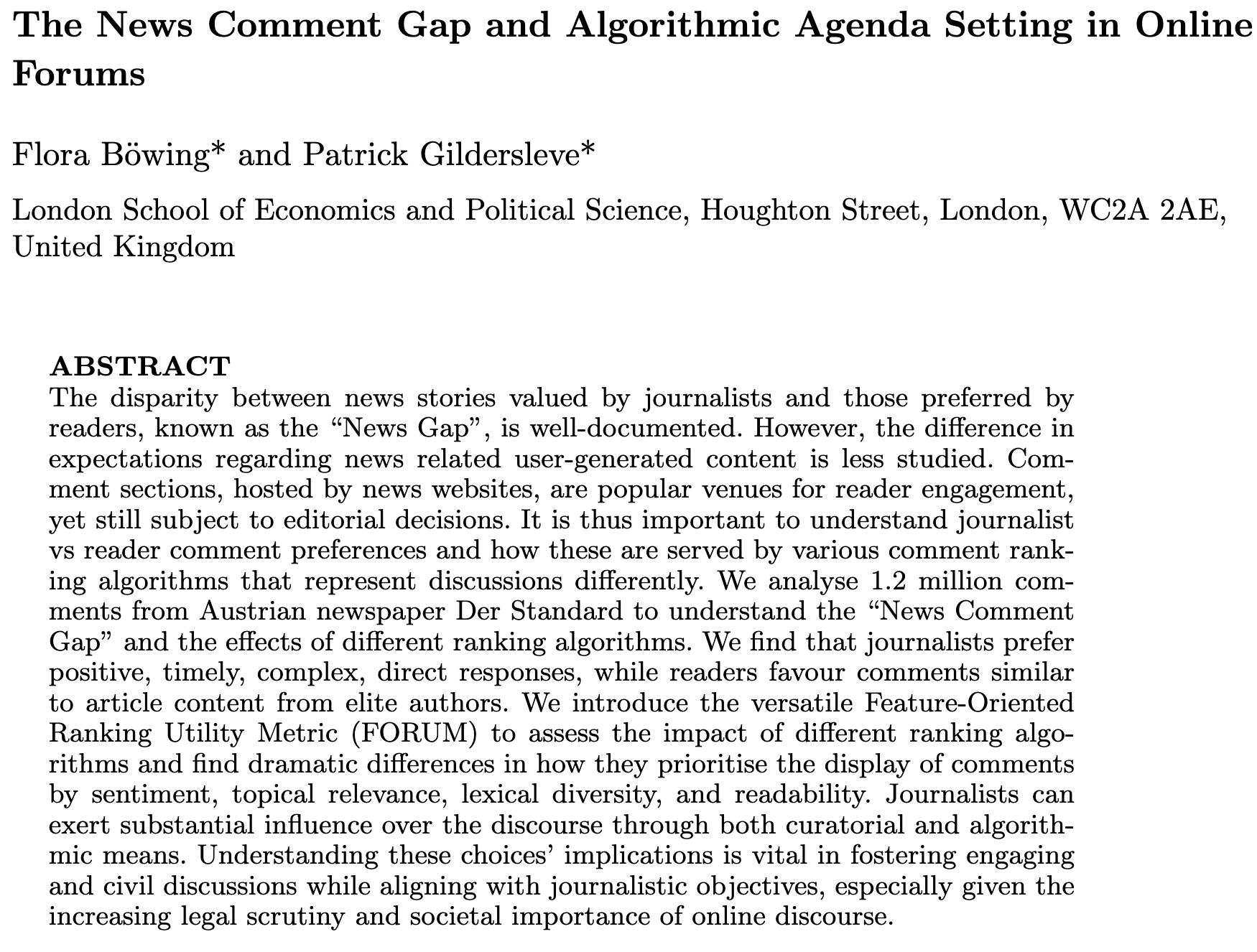
<p>📰The News Comment Gap and Algorithmic Agenda Setting in Online Forums w/ Flora Böwing</p>

<p>We study:</p>
<ol>
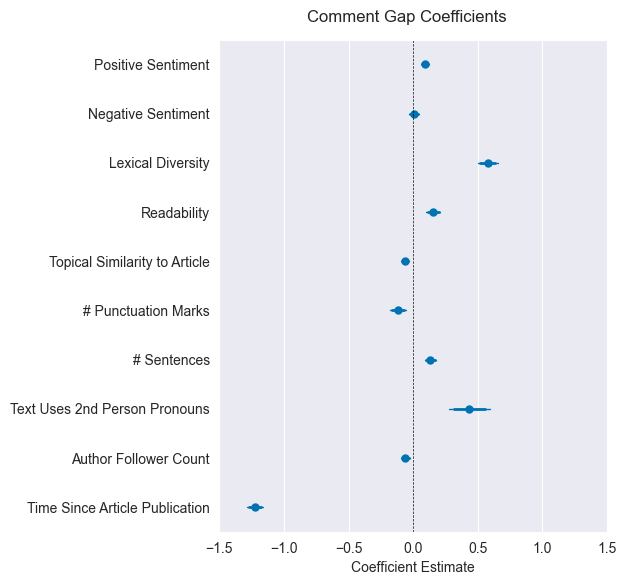
  <li>The differences in comment preferences between journalists and readers</li>
  <li>How comment ranking algorithms prioritise different kinds of comments to display to users</li>
</ol>

<figure class="third ">
  
    
      <a href="/assets/images/2024-08-14-Comment-Gap-Preprint/comment-gap-abstract.png">
          <img src="/assets/images/2024-08-14-Comment-Gap-Preprint/comment-gap-abstract.png" alt="Screenshot of paper title and abstract." />
      </a>


      <a href="/assets/images/2024-08-14-Comment-Gap-Preprint/pinvscompoundcomment.png">
          <img src="/assets/images/2024-08-14-Comment-Gap-Preprint/pinvscompoundcomment.png" alt="Figure showing the difference in comment preferences between journalists and readers." />
      </a>


      <a href="/assets/images/2024-08-14-Comment-Gap-Preprint/FORUM_tweet_example.png">
          <img src="/assets/images/2024-08-14-Comment-Gap-Preprint/FORUM_tweet_example.png" alt="Figure showing the distribution of FORUM scores for Lexical Diversity over the first 10 comments for different ranking algorithms." />
      </a>


    <figcaption>
</figcaption>
  
</figure>

<p>🕵️With data from DER STANDARD, we find, compared to readers, journalists prefer more positive, timely, complex, direct responses, while readers favour comments similar to article content from elite authors.</p>

<figure class="align-center width-50">
  
    
      <a href="/assets/images/2024-08-14-Comment-Gap-Preprint/pinvscompoundcomment.png">
          <img src="/assets/images/2024-08-14-Comment-Gap-Preprint/pinvscompoundcomment.png" alt="Figure showing the difference in comment preferences between journalists and readers." />
      </a>


    <figcaption>
</figcaption>
  
</figure>

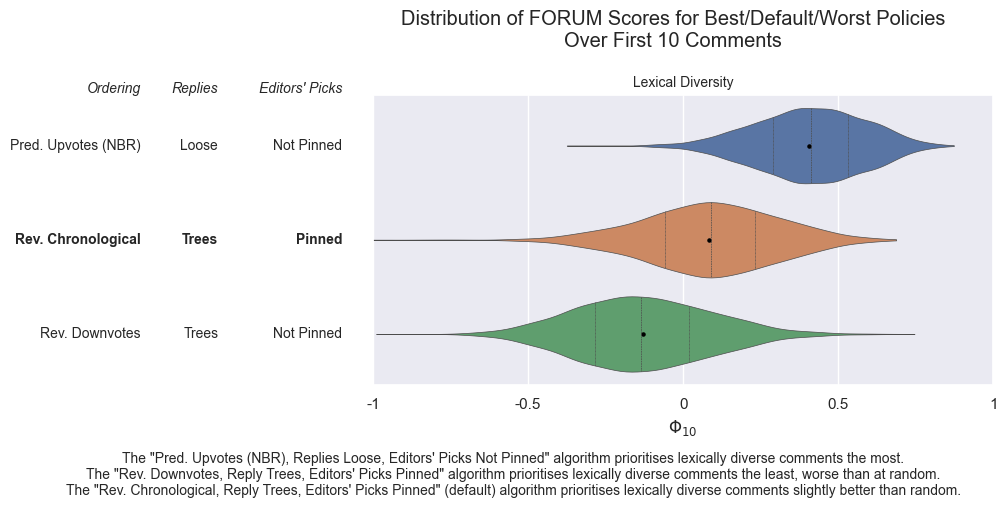
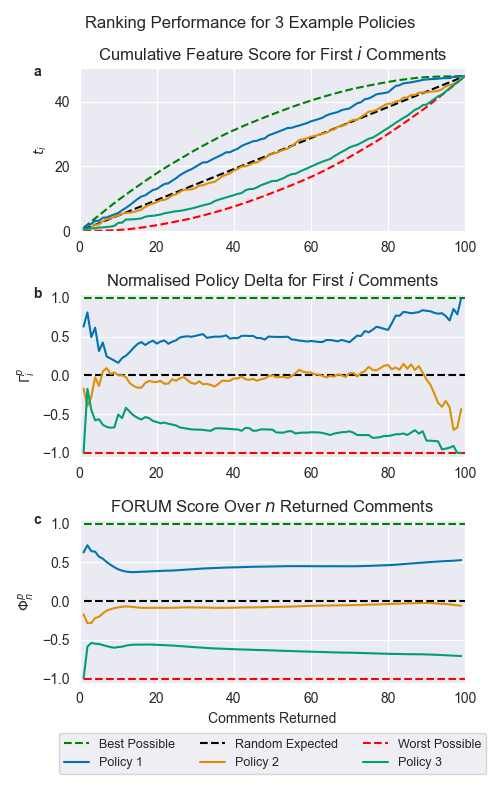
<p>📈We develop the Feature-Oriented Ranking Utility Metric (FORUM 🥁) to evaluate how well a ranking algorithm (most upvoted, chronological, etc) returns comments by a certain feature (sentiment, readability, etc) compared to best/worst-possible and random baseline.</p>

<figure class="align-center width-50">
  
    
      <a href="/assets/images/2024-08-14-Comment-Gap-Preprint/sorting_performance.png">
          <img src="/assets/images/2024-08-14-Comment-Gap-Preprint/sorting_performance.png" alt="Figure showing how FORUM score is calculated." />
      </a>


    <figcaption>
</figcaption>
  
</figure>

<p>🛠️FORUM is a versatile, interpretable tool that can be applied to any task of scoring how well a set of items are sorted, far more than just news comments!</p>

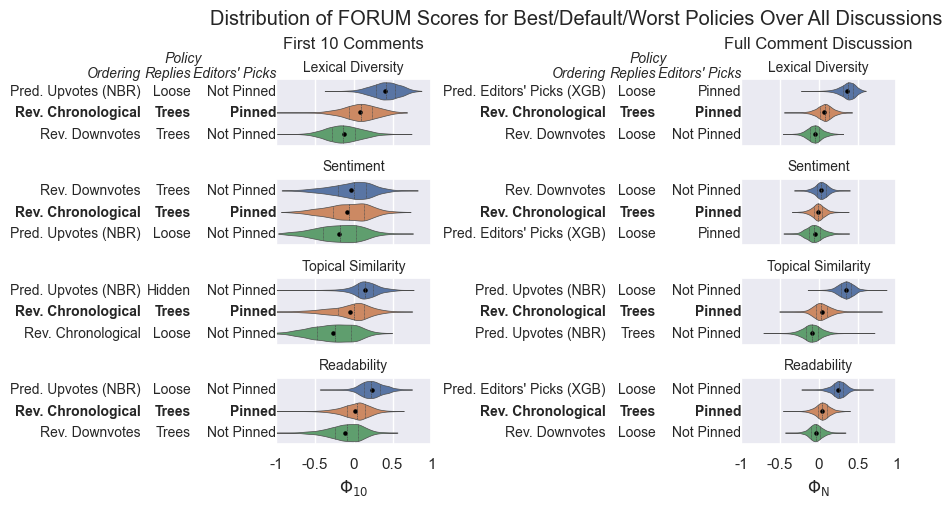
<p>🔍With FORUM, we find dramatic differences in how different, even simple, algorithms prioritise different kinds of comments, as measured by their sentiment, readability, lexical diversity, and similarity to the article.</p>

<figure class="align-center width-50">
  
    
      <a href="/assets/images/2024-08-14-Comment-Gap-Preprint/qdist_best_default_worst.png">
          <img src="/assets/images/2024-08-14-Comment-Gap-Preprint/qdist_best_default_worst.png" alt="Figure showing the distribution of FORUM scores for several features over the first 10 comments and full discussion for different ranking algorithms." />
      </a>


    <figcaption>
</figcaption>
  
</figure>

<p>💪We thus argue editors can exercise agenda setting power in comment sections through curational and algorithmic means.
The effects on how audience reception to an article is represented by ranking algorithms are larger than those from more traditional measures (e.g. Editor Picks).</p>

<p>🗣️Understanding these preferences and algorithmic consequences is vital in fostering healthy discussion online and of clear interest to journalists presenting their stories.
This is especially important given the increasing scrutiny of online speech and how it is hosted/moderated.</p>

<p>👨‍🏫I presented this work at IC2S2 2024.
📖To find out more, check out the following:
🔗Preprint link: <a href="https://arxiv.org/abs/2408.07052">https://arxiv.org/abs/2408.07052</a>
🐍Try FORUM in Python: <a href="https://github.com/pgilders/pyforum">https://github.com/pgilders/pyforum</a></p>

<p>🌟Finally, big thanks to Flora, this project came out of her prizewinning work at LSE Methodology!</p>]]></content><author><name>{&quot;name&quot;=&gt;nil, &quot;avatar&quot;=&gt;&quot;/assets/images/bio.jpg&quot;, &quot;bio&quot;=&gt;&quot; &quot;, &quot;location&quot;=&gt;nil, &quot;email&quot;=&gt;nil, &quot;links&quot;=&gt;[{&quot;label&quot;=&gt;&quot;p.gildersleve@exeter.ac.uk&quot;, &quot;icon&quot;=&gt;&quot;fas fa-fw fa-envelope&quot;, &quot;url&quot;=&gt;&quot;mailto:p.gildersleve@exeter.ac.uk&quot;}, {&quot;label&quot;=&gt;&quot;Google Scholar&quot;, &quot;url&quot;=&gt;&quot;https://scholar.google.co.uk/citations?user=3CTTLDgAAAAJ&quot;, &quot;icon&quot;=&gt;&quot;fas fa-fw fa-graduation-cap&quot;}, {&quot;label&quot;=&gt;&quot;@gildersleve.uk&quot;, &quot;icon&quot;=&gt;&quot;fab fa-fw fa-bluesky&quot;, &quot;url&quot;=&gt;&quot;https://bsky.app/profile/gildersleve.uk&quot;}, {&quot;label&quot;=&gt;&quot;@pgildersleve&quot;, &quot;icon&quot;=&gt;&quot;fab fa-fw fa-x-twitter&quot;, &quot;url&quot;=&gt;&quot;https://x.com/pgildersleve&quot;}, {&quot;label&quot;=&gt;&quot;gildersleve@mastodon.social&quot;, &quot;icon&quot;=&gt;&quot;fab fa-fw fa-mastodon&quot;, &quot;url&quot;=&gt;&quot;https://mastodon.social/@gildersleve&quot;}, {&quot;label&quot;=&gt;&quot;@pgilders&quot;, &quot;icon&quot;=&gt;&quot;fab fa-fw fa-github&quot;, &quot;url&quot;=&gt;&quot;https://github.com/pgilders&quot;}, {&quot;label&quot;=&gt;&quot;LinkedIn&quot;, &quot;url&quot;=&gt;&quot;https://www.linkedin.com/in/gildersleve/&quot;, &quot;icon&quot;=&gt;&quot;fab fa-fw fa-linkedin&quot;}]}</name></author><category term="post" /><category term="preprint" /><category term="paper" /><summary type="html"><![CDATA[The News Comment Gap and Algorithmic Agenda Setting in Online Forums w/ Flora Böwing]]></summary></entry><entry><title type="html">New job</title><link href="https://gildersleve.uk/New-job/" rel="alternate" type="text/html" title="New job" /><published>2024-06-06T12:15:00+00:00</published><updated>2024-06-06T12:15:00+00:00</updated><id>https://gildersleve.uk/New-job</id><content type="html" xml:base="https://gildersleve.uk/New-job/"><![CDATA[<p>Delighted to share that I will be starting as Lecturer (≈ TT Asst Prof) in Communications and Artificial Intelligence at University of Exeter this September. Looking forward to this new chapter! 🥳</p>

<blockquote class="twitter-tweet" data-dnt="true"><p lang="en" dir="ltr">ExeterComms is excited to announce the arrival of new staff! First up, Dr. Patrick Gildersleve <a href="https://twitter.com/pgildersleve?ref_src=twsrc%5Etfw">@pgildersleve</a> will be joining us in September from <a href="https://twitter.com/MethodologyLSE?ref_src=twsrc%5Etfw">@MethodologyLSE</a> as Lecturer in Communications and Artificial Intelligence, with a PhD from <a href="https://twitter.com/oiioxford?ref_src=twsrc%5Etfw">@oiioxford</a> 🤖💻 <a href="https://t.co/ryhKB4WEmB">pic.twitter.com/ryhKB4WEmB</a></p>&mdash; Communications @UniofExeter (@ExeterComms) <a href="https://twitter.com/ExeterComms/status/1798688178393743639?ref_src=twsrc%5Etfw">June 6, 2024</a></blockquote>
<script async="" src="https://platform.twitter.com/widgets.js" charset="utf-8"></script>]]></content><author><name>{&quot;name&quot;=&gt;nil, &quot;avatar&quot;=&gt;&quot;/assets/images/bio.jpg&quot;, &quot;bio&quot;=&gt;&quot; &quot;, &quot;location&quot;=&gt;nil, &quot;email&quot;=&gt;nil, &quot;links&quot;=&gt;[{&quot;label&quot;=&gt;&quot;p.gildersleve@exeter.ac.uk&quot;, &quot;icon&quot;=&gt;&quot;fas fa-fw fa-envelope&quot;, &quot;url&quot;=&gt;&quot;mailto:p.gildersleve@exeter.ac.uk&quot;}, {&quot;label&quot;=&gt;&quot;Google Scholar&quot;, &quot;url&quot;=&gt;&quot;https://scholar.google.co.uk/citations?user=3CTTLDgAAAAJ&quot;, &quot;icon&quot;=&gt;&quot;fas fa-fw fa-graduation-cap&quot;}, {&quot;label&quot;=&gt;&quot;@gildersleve.uk&quot;, &quot;icon&quot;=&gt;&quot;fab fa-fw fa-bluesky&quot;, &quot;url&quot;=&gt;&quot;https://bsky.app/profile/gildersleve.uk&quot;}, {&quot;label&quot;=&gt;&quot;@pgildersleve&quot;, &quot;icon&quot;=&gt;&quot;fab fa-fw fa-x-twitter&quot;, &quot;url&quot;=&gt;&quot;https://x.com/pgildersleve&quot;}, {&quot;label&quot;=&gt;&quot;gildersleve@mastodon.social&quot;, &quot;icon&quot;=&gt;&quot;fab fa-fw fa-mastodon&quot;, &quot;url&quot;=&gt;&quot;https://mastodon.social/@gildersleve&quot;}, {&quot;label&quot;=&gt;&quot;@pgilders&quot;, &quot;icon&quot;=&gt;&quot;fab fa-fw fa-github&quot;, &quot;url&quot;=&gt;&quot;https://github.com/pgilders&quot;}, {&quot;label&quot;=&gt;&quot;LinkedIn&quot;, &quot;url&quot;=&gt;&quot;https://www.linkedin.com/in/gildersleve/&quot;, &quot;icon&quot;=&gt;&quot;fab fa-fw fa-linkedin&quot;}]}</name></author><category term="post" /><summary type="html"><![CDATA[Delighted to share that I will be starting as Lecturer (≈ TT Asst Prof) in Communications and Artificial Intelligence at University of Exeter this September. Looking forward to this new chapter! 🥳]]></summary></entry><entry><title type="html">Graduation 2023</title><link href="https://gildersleve.uk/Graduation-2023/" rel="alternate" type="text/html" title="Graduation 2023" /><published>2023-12-20T16:10:00+00:00</published><updated>2023-12-20T16:10:00+00:00</updated><id>https://gildersleve.uk/Graduation-2023</id><content type="html" xml:base="https://gildersleve.uk/Graduation-2023/"><![CDATA[<p>Super proud of my MSc supervisees who graduated from LSE last week. All achieved distinctions in their dissertations and degrees, including the top MSc project award! 🎉</p>

<p>Keep an eye out for Flora’s prizewinning project “Measuring the comment gap: A machine learning and quantitative text analysis approach to studying news media user comments” in preprint in the near future 👀</p>

<figure class="align-center width-50">
  
    
      <a href="/assets/images/2023-12-20-Graduation-2023/graduation2023.png">
          <img src="/assets/images/2023-12-20-Graduation-2023/graduation2023.png" alt="Me in a suit with three graduating students in their robes." />
      </a>


    <figcaption>Graduation reception.
</figcaption>
  
</figure>]]></content><author><name>{&quot;name&quot;=&gt;nil, &quot;avatar&quot;=&gt;&quot;/assets/images/bio.jpg&quot;, &quot;bio&quot;=&gt;&quot; &quot;, &quot;location&quot;=&gt;nil, &quot;email&quot;=&gt;nil, &quot;links&quot;=&gt;[{&quot;label&quot;=&gt;&quot;p.gildersleve@exeter.ac.uk&quot;, &quot;icon&quot;=&gt;&quot;fas fa-fw fa-envelope&quot;, &quot;url&quot;=&gt;&quot;mailto:p.gildersleve@exeter.ac.uk&quot;}, {&quot;label&quot;=&gt;&quot;Google Scholar&quot;, &quot;url&quot;=&gt;&quot;https://scholar.google.co.uk/citations?user=3CTTLDgAAAAJ&quot;, &quot;icon&quot;=&gt;&quot;fas fa-fw fa-graduation-cap&quot;}, {&quot;label&quot;=&gt;&quot;@gildersleve.uk&quot;, &quot;icon&quot;=&gt;&quot;fab fa-fw fa-bluesky&quot;, &quot;url&quot;=&gt;&quot;https://bsky.app/profile/gildersleve.uk&quot;}, {&quot;label&quot;=&gt;&quot;@pgildersleve&quot;, &quot;icon&quot;=&gt;&quot;fab fa-fw fa-x-twitter&quot;, &quot;url&quot;=&gt;&quot;https://x.com/pgildersleve&quot;}, {&quot;label&quot;=&gt;&quot;gildersleve@mastodon.social&quot;, &quot;icon&quot;=&gt;&quot;fab fa-fw fa-mastodon&quot;, &quot;url&quot;=&gt;&quot;https://mastodon.social/@gildersleve&quot;}, {&quot;label&quot;=&gt;&quot;@pgilders&quot;, &quot;icon&quot;=&gt;&quot;fab fa-fw fa-github&quot;, &quot;url&quot;=&gt;&quot;https://github.com/pgilders&quot;}, {&quot;label&quot;=&gt;&quot;LinkedIn&quot;, &quot;url&quot;=&gt;&quot;https://www.linkedin.com/in/gildersleve/&quot;, &quot;icon&quot;=&gt;&quot;fab fa-fw fa-linkedin&quot;}]}</name></author><category term="post" /><summary type="html"><![CDATA[Super proud of my MSc supervisees who graduated from LSE last week. All achieved distinctions in their dissertations and degrees, including the top MSc project award! 🎉]]></summary></entry><entry><title type="html">Elon Musk is right about Wikipedia</title><link href="https://gildersleve.uk/Elon-Musk-is-right-about-Wikipedia/" rel="alternate" type="text/html" title="Elon Musk is right about Wikipedia" /><published>2023-10-30T14:00:00+00:00</published><updated>2023-10-30T14:00:00+00:00</updated><id>https://gildersleve.uk/Elon-Musk-is-right-about-Wikipedia</id><content type="html" xml:base="https://gildersleve.uk/Elon-Musk-is-right-about-Wikipedia/"><![CDATA[<p><em>TL;DR: No.</em></p>

<h2 id="the-case-against-wikipedia">The case against Wikipedia</h2>

<p>Last week Elon Musk posted a number of tweets denouncing Wikipedia, the free online encyclopaedia that has been a mainstay of the 21st century Internet.</p>

<figure class="align-center width-50">
  
    
      <a href="/assets/images/2023-10-30-Elon-Musk-is-right-about-Wikipedia/wokipedia.png">
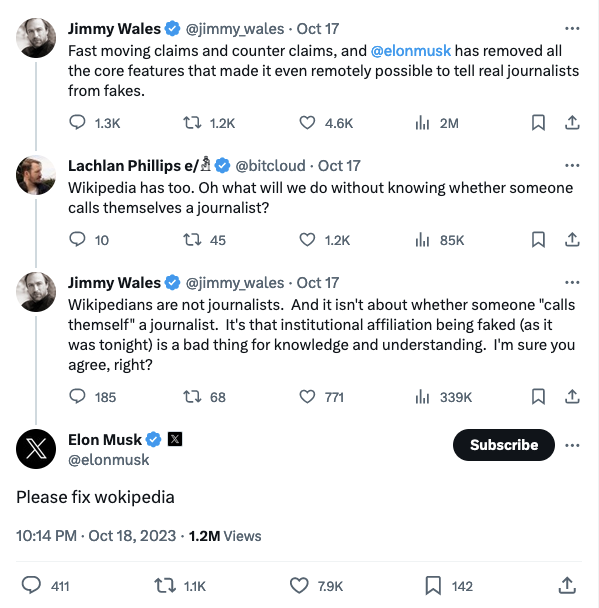
          <img src="/assets/images/2023-10-30-Elon-Musk-is-right-about-Wikipedia/wokipedia.png" alt="Screenshot of a Twitter thread started by Jimmy Wales, first tweet reading: 'Fast moving claims and counter claims, and @elonmusk has removed all the core features that made it even remotely possible to tell real journalists from fakes.'. A response from Elon Mush reads 'Please fix wokipedia'." />
      </a>


    <figcaption><a href="https://twitter.com/elonmusk/status/1714751916482171179">Tweet Source</a>
</figcaption>
  
</figure>

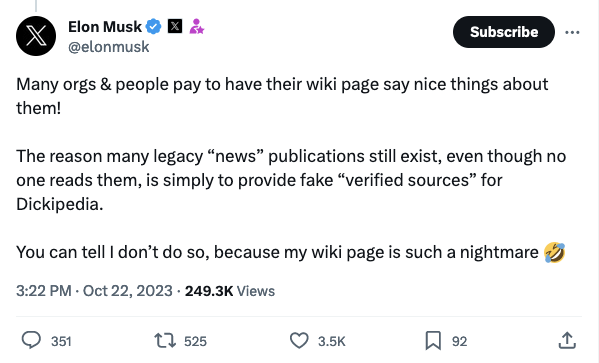
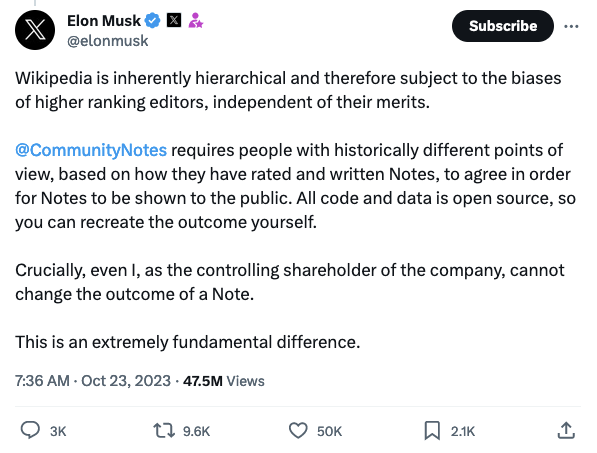
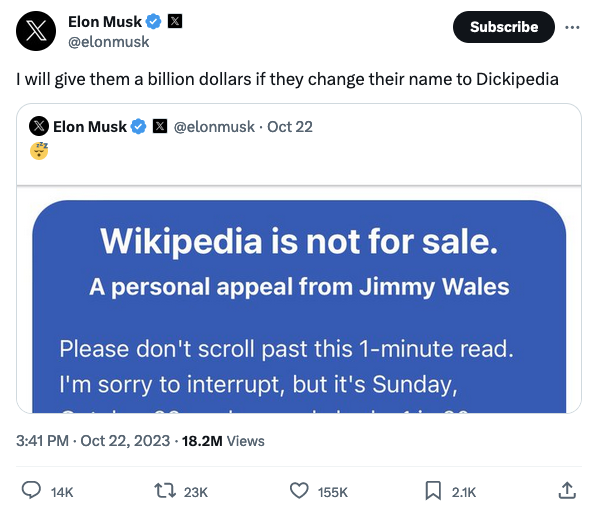
<p>The attack came in response to Wikipedia co-founder Jimmy Wales’ complaints that the hamstringing of X/Twitter’s blue tick verification system has made trusting information on the Israel-Palestine conflict on Twitter particularly difficult. Elon’s erudite response was to “Please fix Wokipedia” (I personally prefer <a href="https://starwars.fandom.com/wiki/Main_Page">Wookiepedia</a>). This was followed up by a number of other critical tweets noting biased editors, an assertion that the entire “legacy” news industry exists solely to fabricate authoritative false information for Wikipedia (???), and an offer of $1bn for the site to change its name to Dickipedia (you’d think he’d have learnt after the previous Twitter board <a href="https://edition.cnn.com/2022/07/08/tech/elon-musk-twitter-deal-exit/index.html">called his bluff</a> on his inflated purchase offer).</p>

<figure class="align-center width-50">
  
    
      <a href="/assets/images/2023-10-30-Elon-Musk-is-right-about-Wikipedia/donations.png">
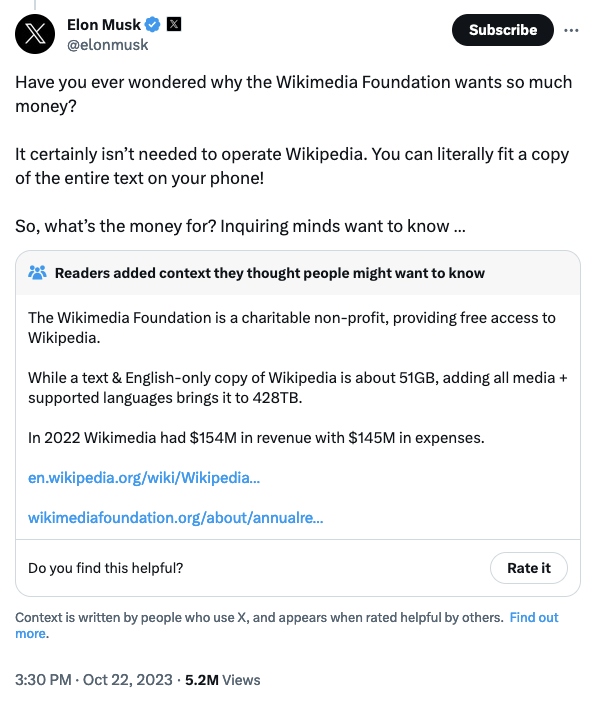
          <img src="/assets/images/2023-10-30-Elon-Musk-is-right-about-Wikipedia/donations.png" alt="Screenshot of a tweet by Elon Musk stating: 'Have you ever wondered why the Wikimedia Foundation wants so much money? It certainly isn’t needed to operate Wikipedia. You can literally fit a copy of the entire text on your phone. So, what’s the money for? Inquiring minds want to know …'. A community note responds: 'The Wikimedia Foundation is a charitable non-profit, providing free access to Wikipedia. While a text &amp; English-only copy of Wikipedia is about 51GB, adding all media + supported languages brings it to 428TB. In 2022 Wikimedia had $154M in revenue with $145M in expenses.'" />
      </a>


    <figcaption><a href="https://twitter.com/elonmusk/status/1716099814264328390">Tweet Source</a>
</figcaption>
  
</figure>

<figure class="third ">
  
    
      <a href="/assets/images/2023-10-30-Elon-Musk-is-right-about-Wikipedia/legacynews.png">
          <img src="/assets/images/2023-10-30-Elon-Musk-is-right-about-Wikipedia/legacynews.png" alt="Screenshot of a tweet by Elon Musk stating: 'Many orgs &amp; people pay to have their wiki page say nice things about them! The reason many legacy “news” publications still exist, even though no one reads them, is simply to provide fake “verified sources” for Dickipedia. You can tell I don’t do so, because my wiki page is such a nightmare'" />
      </a>


      <a href="/assets/images/2023-10-30-Elon-Musk-is-right-about-Wikipedia/notes.png">
          <img src="/assets/images/2023-10-30-Elon-Musk-is-right-about-Wikipedia/notes.png" alt="Screenshot of a tweet by Elon Musk stating: 'Wikipedia is inherently hierarchical and therefore subject to the biases of higher ranking editors, independent of their merits. @CommunityNotes requires people with historically different points of view, based on how they have rated and written Notes, to agree in order for Notes to be shown to the public. All code and data is open source, so you can recreate the outcome yourself. Crucially, even I, as the controlling shareholder of the company, cannot change the outcome of a Note. This is an extremely fundamental difference.'" />
      </a>


      <a href="/assets/images/2023-10-30-Elon-Musk-is-right-about-Wikipedia/dickipedia.png">
          <img src="/assets/images/2023-10-30-Elon-Musk-is-right-about-Wikipedia/dickipedia.png" alt="Screenshot of a tweet by Elon Musk stating: 'I will give them a billion dollars if they change their name to Dickipedia'." />
      </a>


    <figcaption>Tweet Source <a href="https://twitter.com/elonmusk/status/1716097732627067224">1</a>, <a href="https://twitter.com/elonmusk/status/1716342871916257739">2</a>, <a href="https://twitter.com/elonmusk/status/1716102436123783175">3</a>.
</figcaption>
  
</figure>

<p>In the midst of this, wider scrutiny of how the Wikimedia Foundation—the charity that runs Wikipedia and its sister projects—appeals for and spends its money has increased. Elon’s flurry of tweets with this line of questioning was backed up by various efforts from supporters analysing the foundations donation figures, each declaring that one of the most popular websites in the world—plus the operations of its parent organisation—could and should be done much more cheaply.</p>

<h2 id="the-encyclopaedic-view">The encyclopaedic view</h2>

<p>All of this seems part of a larger trend in the alt right anti-intellectual movement. In addition to donation transparency and payroll issues, there have been protests over how the article for “Recession” was <a href="https://www.npr.org/2022/07/29/1114599942/wikipedia-recession-edits">supposedly edited</a> to preserve the reputation of Joe Biden’s presidency, and <a href="https://www.foxnews.com/media/elon-musk-slams-wikipedia-considering-deletion-twitter-files-entry-non-trivial-left-wing-bias">outcry</a> over editor discussions to delete the fledging article for the “Twitter Files”.</p>

<p>These complaints go back many years, and have occasionally sparked attempts to form alternatives to Wikipedia that are more exclusively in line with the views and interests of particular communities (with varying degrees of extremity), including but not limited to the Christian fundamentalist Conservapedia, the alt right Infogalactic, or the blockchain-based IQ.Wiki (formerly Everipedia). Many of these attempts have failed, and those that are still around are but a shadow of Wikipedia’s success.</p>

<p>There are certainly valid points to be made on critiquing the Wikimedia Foundation’s donation transparency. However, this posturing on Twitter with misplaced confidence in accounting only serves as a bad faith pretext by which to belittle Wikipedia’s entire mission. Engaging in debate here over what of the Wikimedia Foundation’s expenses constitutes appropriate spending or value for money in this case is besides the point; indeed, much more worthwhile discussions on this occur on <a href="https://en.wikipedia.org/wiki/Wikipedia:Wikipedia_Signpost/2021-06-27/Forum">Wikipedia itself</a>. Moreover, the release of the files is not the scandalous result of some clever sleuthing, or shocking hack. <a href="https://en.wikipedia.org/wiki/Wikipedia:Wikipedia_Signpost/2023-10-03/News_and_notes">The documents</a> were published (and will continue to be) by the Wikimedia Foundation after Wikipedians themselves campaigned for greater donation transparency. It is the product of a functioning relationship between the editing community and Wikipedia’s stewards. With that out of the way, what of Musk’s underlying concerns with Wikipedia: are they valid? Inquiring minds want to know…</p>

<p>Here I will detail how the way Wikipedia operates, together with academic Wiki research, shows that Elon Musk may have a point, but not in the way he might hope or expect.</p>

<h2 id="wikipedia-does-not-represent-musks-views">Wikipedia does not represent Musk’s views</h2>

<p>People regularly confuse Wikipedia’s “Neutral Point Of View” (NPOV) Policy as an expectation that an article to should give equal weight to both sides of an issue. This is incorrect. NPOV dictates that articles should proportionately represent the significant views from reliable sources on a topic. This means that perspectives from flat earthers, climate change deniers, race realists, etc. are broadly not able to flourish unchecked (unlike on certain other social media platforms…), since authoritative sources do not support these positions. Simply put, some of Musk’s views are not backed up by authoritative sources and so do not receive the coverage he expects on Wikipedia. A Wikipedia article is also not the place to argue over the truth of a matter, but to present information as represented in other sources. For editorial discussions, each article has an associated “Talk” page. Scientific and historical publishing, journalism, and even the chatter of social media are the venues for hashing out debate.</p>

<p>Since Wikipedia is a continual work in progress, it of course does not always live up to this ideal. If Musk or his fans do find that an article is not neutrally presented then they would be welcome to participate and make a contribution to the digital commons, rather than decry Wikipedia as some exclusionary club. In these situations, provided the information is well-sourced, the guidance is to rewrite or add to the article, rather than completely remove the content (or indeed leave it in place). Indeed, it has been found that diverse editor teams produce higher quality articles <a href="#references">[1]</a>. This process can sometimes be hard work, but you don’t just get what you want without effort to build consensus.</p>

<h2 id="wikipedia-is-biased">Wikipedia is biased</h2>

<p>Given Wikipedia’s reliance on particular sources and editorial processes, it is perhaps not surprising that this could lead to more systemic issues of bias. What if what Wikipedia deems as authoritative sources do not exist, or misrepresent an issue? Elon and the gang have identified another key issue with Wikipedia.</p>

<p>Countless studies have explored the biases present in English, and across all language versions of Wikipedia <a href="#references">[2–6]</a>. These consistently find that traditionally marginalised groups (women, LGBTQ people, communities from the global south, etc) are underrepresented as a whole on Wikipedia. Beyond the content itself, the editor demographics skew strongly towards white, western men, and that western editors are overrepresented across different language Wikipedias <a href="#references">[6]</a>. This perhaps partly explains the aforementioned content biases. Different parts of, or language editions, of Wikipedia can still present different perspectives on a given topic. This is perhaps most clear when there is a lack of diversity in contributing editors. For example, when the Wikipedia language is tied to a particular national identity, content on Wikipedia can be more akin to digital collective memory <a href="#references">[7]</a>. Consider coverage on the Japanese Wikipedia of Japan’s <a href="https://ja-m-wikipedia-org.translate.goog/wiki/%E5%8D%97%E4%BA%AC%E4%BA%8B%E4%BB%B6?_x_tr_sl=ja&amp;_x_tr_tl=en&amp;_x_tr_hl=en-US&amp;_x_tr_pto=wapp">actions in World War 2</a> or the <a href="https://ja-m-wikipedia-org.translate.goog/wiki/%E6%97%A5%E6%9C%AC%E3%81%B8%E3%81%AE%E5%8E%9F%E5%AD%90%E7%88%86%E5%BC%BE%E6%8A%95%E4%B8%8B?_x_tr_sl=ja&amp;_x_tr_tl=en&amp;_x_tr_hl=en-US&amp;_x_tr_pto=wapp">Atomic Bombings</a> and how it might diverge from the English or Chinese Wikipedias. Regarding ideological bias specifically; whilst it is difficult to study at scale, some studies have found that the English Wikipedia is slightly left-leaning, but that this weakens over time as both articles receive more edits and editors become more experienced <a href="#references">[8, 9]</a>.</p>

<p>There is regular debate over to what extent Wikipedia should reflect biases present in the communities it represents / written sources / the Internet. However, the fact remains that at best, Wikipedia reflects, and at worst amplifies and exacerbates biases present in the world.</p>

<h2 id="established-wikipedia-editors-control-the-content">Established Wikipedia editors control the content</h2>

<p>More established editors do have more power on Wikipedia. Musk’s frustations in some way echo those of many new users who attempt to edit the site; one can attempt to make good faith edits, and be met with unexpected resistance, rewrites, or reverts. Certain active editors may also patrol their favourite articles and topics, polishing any contributions made by others and reverting any changes that they deem unworthy.</p>

<p>Whilst Wikipedia is the encyclopaedia that “anyone can edit”, there is still a editorial hierarchy—from unregistered editors, to “Extended Confirmed” users (active for at least 30 days with at least 500 edits), up to Administrators and Bureaucrats, who receive special privileges such as the ability to delete articles or block users. None of these roles are paid, and all are decided by simple activity rules or the volunteer editing community, not the Wikimedia Foundation. If there are serious disputes by editors over the content of a given article, these escalate up the community governance structure where other editors will weigh in and attempt to reach a consensus. This is a fundamental part of the miraculous success of Wikipedia, where experience and expertise is valued but not revered. That being said, it can still be a confusing process for new editors who, if facing off against an experienced editor, can be met with policy acronyms and counter-measures that they are not familiar with. Hell hath no fury like a Wikipedia editor scorned.</p>

<figure class="align-center width-50">
  
    
      <a href="https://imgs.xkcd.com/comics/duty_calls.png">
          <img src="https://imgs.xkcd.com/comics/duty_calls.png" alt="xkcd comic 'Duty Calls'. Stick drawing of person at a computer having a conversation with someone offscreen asking 'Are you coming to bed?', 'I can't. This is important.', 'What?', 'Someone is WRONG on the Internet.'" />
      </a>


    <figcaption><a href="https://xkcd.com/386/">xkcd: Duty Calls</a>
</figcaption>
  
</figure>

<p>What all of this often tedious, occasionally explosive procedure means is that Wikipedia is not some “free speech” free-for-all, where acolytes may purchase some empty social status symbol with elevated privileges in the digital public sphere (too on-the-nose?). The process of cumulative consensus building is not perfect, but it has developed to be robust to vandalism and coordinated interference. Whilst the rules of engagement can be abused, it is a far cry from the helpless situation Musk and his allies claim to find themseleves in.</p>

<h2 id="wikipedia-administration-has-been-taken-over">Wikipedia administration has been taken over</h2>

<p>OK, but what if the entire system is rigged? That beyond individual cases of editors acting in bad faith, the rot runs so deep that the community hierarchy has been fatally compromised by bad actors?</p>

<p>Such levels of conspiratorial coordination would be a challenge in any organisation, let alone in a distributed social system on the scale of English Wikipedia. However, this scenario did play out on the Croatian Wikipedia. In 2021, after years of complaints from regular Croatian editors, the Wikimedia Foundation launched the <a href="https://meta.wikimedia.org/wiki/Croatian_Wikipedia_Disinformation_Assessment-2021">Croatian Wikipedia Disinformation Assessment</a>. The Foundation found that the volunteer administrator team, the editors with the most power on the site, was actively pushing far right nationalist content. The Croatian editing community removed the offending administrators and, with the support of the report, is seeking to rebuild the administrative hierarchy. A similar intervention was made on the Arabic Wikipedia in 2022, when the Wikimedia Foundation <a href="https://en.wikipedia.org/wiki/Wikipedia:Wikipedia_Signpost/2023-01-01/News_and_notes">banned seven administrator</a> for conflict of interest editing. <a href="https://dawnmena.org/saudi-arabia-government-agents-infiltrate-wikipedia-sentence-independent-wikipedia-administrators-to-prison/">Whistleblowers later claimed</a> the banned administrators were directly linked to the Saudi Government and partly responsible for the arrests and imprisonment of dissenting editors Ziyad al-Sofiani and Osama Khalid.</p>

<p>Wikipedia is absolutely not immune to attacks by bad actors or misinformation. These examples are particularly serious incidents, and demonstrate the tightrope act the Wikimedia Foundation must follow. However, the idea that a liberal cabal is pulling the strings in an already biased system is fanciful. Given Wikipedia’s history on the matter, it is yet another example of the far right accusing those on the left of what they themselves have already done or intend to do.</p>

<h2 id="full-marks-for-musk">Full marks for Musk?</h2>

<p>So yes, Elon Musk is right about Wikipedia. It does not represent his views, it is biased, established editors control the content, to the extent that the entire community hierarchy has been infiltrated.</p>

<p>However, as discussed, his beliefs are not represented as they are unsubstantiated, Wikipedia’s biases run counter to Musk’s expectations, hierarchical control is a necessary part of the consensus system, and attempts at administrative takeover have only been made by the far right.</p>

<p>The victim complex displayed by Musk is striking, if unsurprising. Wikipedia as a functioning, even flourishing, online social system after all these years stands in stark contrast to what Musk’s Twitter is fast becoming, all for a lot less than $44bn.</p>

<h2 id="the-future-of-wikipedia">The future of Wikipedia</h2>

<p>Despite Musk’s misguided misgivings, we have nevertheless seen the genuine issues that do exist with Wikipedia. These broadly boil down to knowledge gaps and editorial control. Knowledge gaps are a problem. Wikipedia is often a first port of call when researching a subject, plus Wikipedia coverage in and of itself nowadays conveys a level of legitimacy and notability. Moreover, Wikipedia is a font of information for many other websites and services, playing an important role in powering the knowledge graphs used by Google, Meta, and Amazon Alexa, as well as forming a key part of the texts used to train Large Language Model such as ChatGPT. What happens on Wikipedia echoes across many other platforms. Likewise, editor abuse of power or process can be an issue. We do not want this important online resource to be controlled by the decisions of a select few. We have already seen the consequences of this with the far more culturally maligned big social media platforms—Twitter of course included.</p>

<p>The Wikimedia Foundation is conscious of its issues and is already running numerous initiatives to address them. This includes developing schemes to improve the experience of new editors, and their retention. Money also goes towards facilitating events such as edit-a-thons around the world. The foundation rightfully stays out of interfering with the editorial process itself (the vast majority of which remains postive and productive), except for keeping a watchful eye for the most extreme cases, as discussed above.</p>

<p>All of this, plus continued advocacy for open access and open knowledge, wide-ranging support for internal and external research, managing crucial sister projects like Wikidata and Wikimedia Commons, and promoting educational initiatives, is all practised by the foundation. This all helps contribute to what makes Wikipedia the <a href="https://www.wired.com/story/wikipedia-online-encyclopedia-best-place-internet/">“last best place on the Internet”</a>, and a society that embodies its values and can support it going forward.</p>

<p>Wikipedia is far more than just a collection of text on a server somewhere. If you would like to help contribute to the movement, then you are of course welcome to <a href="https://donate.wikimedia.org/w/index.php?title=Special:LandingPage">donate</a>. More importantly though, I would recommend starting to <a href="https://en.wikipedia.org/wiki/Help:Starting_editing">edit</a>. Participating in the process of building the digital commons is a rewarding experience, and your contributions can help make humanity’s greatest reference work (and all its dependents) even better.</p>

<h2 id="references">References</h2>

<p>[1] <a href="https://www.nature.com/articles/s41562-019-0541-6">Shi, F., Teplitskiy, M., Duede, E., &amp; Evans, J. A. (2019). The wisdom of polarized crowds. Nature human behaviour, 3(4), 329-336.</a></p>

<p>[2] <a href="https://www.ncbi.nlm.nih.gov/pmc/articles/PMC3694126/">Hill, B. M., &amp; Shaw, A. (2013). The Wikipedia gender gap revisited: Characterizing survey response bias with propensity score estimation. PloS one, 8(6), e65782.</a></p>

<p>[3] <a href="https://journals.sagepub.com/doi/full/10.1177/14614448211023772">Tripodi, F. (2023). Ms. Categorized: Gender, notability, and inequality on Wikipedia. New Media &amp; Society, 25(7), 1687-1707.</a></p>

<p>[4] <a href="https://www.jstor.org/stable/48641981">Ribé, M. M., Kaltenbrunner, A., &amp; Keefer, J. M. (2021). Bridging LGBT+ Content Gaps Across Wikipedia Language Editions. The International Journal of Information, Diversity, &amp; Inclusion, 5(4), 90-131.</a></p>

<p>[5] <a href="https://www.degruyter.com/document/doi/10.14361/dcs-2019-0109/html">Dittus, M., &amp; Graham, M. (2019). Mapping Wikipedia’s geolinguistic contours. Digital Culture &amp; Society, 5(1), 147-164.</a></p>

<p>[6] <a href="https://www.tandfonline.com/doi/full/10.1080/00045608.2015.1072791">Graham, M., Straumann, R. K., &amp; Hogan, B. (2015). Digital divisions of labor and informational magnetism: Mapping participation in Wikipedia. Annals of the Association of American Geographers, 105(6), 1158-1178.</a></p>

<p>[7] <a href="https://www.sciencedirect.com/science/article/pii/S0079612322001571">Yasseri, T., Gildersleve, P., &amp; David, L. (2022). Chapter 9 - Collective memory in the digital age. In S. M. O’Mara (Ed.), Progress in brain research (Vol. 274, p. 203-226). Elsevier.</a></p>

<p>[8] <a href="https://www.aeaweb.org/articles?id=10.1257%2Faer.102.3.343&amp;ref=daluve-o-blog-de-tecnologia-mais-baseado-do-mundo">Greenstein, S., &amp; Zhu, F. (2012). Is Wikipedia Biased?. American Economic Review, 102(3), 343-348.</a></p>

<p>[9] <a href="https://www.nber.org/papers/w22744">Greenstein, Shane, Yuan Gu, and Feng Zhu. Ideological segregation among online collaborators: evidence from Wikipedians. No. w22744. National Bureau of Economic Research, 2016.</a></p>]]></content><author><name>{&quot;name&quot;=&gt;nil, &quot;avatar&quot;=&gt;&quot;/assets/images/bio.jpg&quot;, &quot;bio&quot;=&gt;&quot; &quot;, &quot;location&quot;=&gt;nil, &quot;email&quot;=&gt;nil, &quot;links&quot;=&gt;[{&quot;label&quot;=&gt;&quot;p.gildersleve@exeter.ac.uk&quot;, &quot;icon&quot;=&gt;&quot;fas fa-fw fa-envelope&quot;, &quot;url&quot;=&gt;&quot;mailto:p.gildersleve@exeter.ac.uk&quot;}, {&quot;label&quot;=&gt;&quot;Google Scholar&quot;, &quot;url&quot;=&gt;&quot;https://scholar.google.co.uk/citations?user=3CTTLDgAAAAJ&quot;, &quot;icon&quot;=&gt;&quot;fas fa-fw fa-graduation-cap&quot;}, {&quot;label&quot;=&gt;&quot;@gildersleve.uk&quot;, &quot;icon&quot;=&gt;&quot;fab fa-fw fa-bluesky&quot;, &quot;url&quot;=&gt;&quot;https://bsky.app/profile/gildersleve.uk&quot;}, {&quot;label&quot;=&gt;&quot;@pgildersleve&quot;, &quot;icon&quot;=&gt;&quot;fab fa-fw fa-x-twitter&quot;, &quot;url&quot;=&gt;&quot;https://x.com/pgildersleve&quot;}, {&quot;label&quot;=&gt;&quot;gildersleve@mastodon.social&quot;, &quot;icon&quot;=&gt;&quot;fab fa-fw fa-mastodon&quot;, &quot;url&quot;=&gt;&quot;https://mastodon.social/@gildersleve&quot;}, {&quot;label&quot;=&gt;&quot;@pgilders&quot;, &quot;icon&quot;=&gt;&quot;fab fa-fw fa-github&quot;, &quot;url&quot;=&gt;&quot;https://github.com/pgilders&quot;}, {&quot;label&quot;=&gt;&quot;LinkedIn&quot;, &quot;url&quot;=&gt;&quot;https://www.linkedin.com/in/gildersleve/&quot;, &quot;icon&quot;=&gt;&quot;fab fa-fw fa-linkedin&quot;}]}</name></author><category term="blog" /><summary type="html"><![CDATA[Elon has taken to Twitter to criticise the last best place on the Internet. Does the man destroying his own social network have a point?]]></summary></entry><entry><title type="html">Index Zero</title><link href="https://gildersleve.uk/Index-Zero/" rel="alternate" type="text/html" title="Index Zero" /><published>2023-10-29T14:31:39+00:00</published><updated>2023-10-29T14:31:39+00:00</updated><id>https://gildersleve.uk/Index-Zero</id><content type="html" xml:base="https://gildersleve.uk/Index-Zero/"><![CDATA[<p>This is the start of my personal blog. I’ll be posting medium to long form content, and reposting across social media.</p>

<p>I’ll revisit this post to explain more about the blog and its motivations, but for now I’ll leave it at that.</p>]]></content><author><name>{&quot;name&quot;=&gt;nil, &quot;avatar&quot;=&gt;&quot;/assets/images/bio.jpg&quot;, &quot;bio&quot;=&gt;&quot; &quot;, &quot;location&quot;=&gt;nil, &quot;email&quot;=&gt;nil, &quot;links&quot;=&gt;[{&quot;label&quot;=&gt;&quot;p.gildersleve@exeter.ac.uk&quot;, &quot;icon&quot;=&gt;&quot;fas fa-fw fa-envelope&quot;, &quot;url&quot;=&gt;&quot;mailto:p.gildersleve@exeter.ac.uk&quot;}, {&quot;label&quot;=&gt;&quot;Google Scholar&quot;, &quot;url&quot;=&gt;&quot;https://scholar.google.co.uk/citations?user=3CTTLDgAAAAJ&quot;, &quot;icon&quot;=&gt;&quot;fas fa-fw fa-graduation-cap&quot;}, {&quot;label&quot;=&gt;&quot;@gildersleve.uk&quot;, &quot;icon&quot;=&gt;&quot;fab fa-fw fa-bluesky&quot;, &quot;url&quot;=&gt;&quot;https://bsky.app/profile/gildersleve.uk&quot;}, {&quot;label&quot;=&gt;&quot;@pgildersleve&quot;, &quot;icon&quot;=&gt;&quot;fab fa-fw fa-x-twitter&quot;, &quot;url&quot;=&gt;&quot;https://x.com/pgildersleve&quot;}, {&quot;label&quot;=&gt;&quot;gildersleve@mastodon.social&quot;, &quot;icon&quot;=&gt;&quot;fab fa-fw fa-mastodon&quot;, &quot;url&quot;=&gt;&quot;https://mastodon.social/@gildersleve&quot;}, {&quot;label&quot;=&gt;&quot;@pgilders&quot;, &quot;icon&quot;=&gt;&quot;fab fa-fw fa-github&quot;, &quot;url&quot;=&gt;&quot;https://github.com/pgilders&quot;}, {&quot;label&quot;=&gt;&quot;LinkedIn&quot;, &quot;url&quot;=&gt;&quot;https://www.linkedin.com/in/gildersleve/&quot;, &quot;icon&quot;=&gt;&quot;fab fa-fw fa-linkedin&quot;}]}</name></author><category term="meta" /><summary type="html"><![CDATA[This is the start of my personal blog. I’ll be posting medium to long form content, and reposting across social media.]]></summary></entry></feed>